As most stamp collectors know, eBay is a giant mish-mash of stuff... from absolute rubbish to incredibly overpriced classics.
That said, you do occasionally come across a "gold nugget" or two. Earlier today, I came across a little "gem" that is perfectly representative of what Swedish town cancel collectors strive to find for their collections.
I know it's certainly the kind of stamp I like to add to my own cancel collection, but you rarely find one like this: It is not only a well-centered stamp without faults (Sweden no. 36, 30 öre ringtyp perf 13), it has a perfectly struck upright cancel.
Although not enormously rare, RÖK is a smaller place and by no means common.
I have seen these types of cancels-- in this quality-- sell at major auction houses in Europe for 100 € or more, so it is interesting to see one like this show up on eBay.
No, it's not mine... the seller is actually in Sweden, and the stamp is open for bids till Sunday, August 31st. This particular seller actually has several nice Swedish cancels up for sale at the moment. Here's a link, if you'd like to go have a look!
A blog and web site about postage stamps and stamp collecting. Focus on Scandinavian Stamps, Postal History and Philately, with occasional sidetrips to Western Europe, British Commonwealth and general worldwide stamps. I've been actively trading stamps since 1985; online since 1998.
Showing posts with label Ringtyp. Show all posts
Sunday, August 24, 2014
Wednesday, August 08, 2012
Up for Auction: Classic Sweden with Varieties and Better Cancels
It's stamp auction time again, and this week the focus is on older Swedish stamps, including varieties and better town cancels.
The Swedish "ringtyp" (or "circle type") stamps of 1872-1891 happen to be one of my areas of specialization-- I collect both plate flaws as well as nicer town cancels on these classic issues. This week I am letting go of a number of duplicates.
All items listed start bidding at just 99 cents, and there is NO reserve... regardless of the stamp's value. Some of these items are quite good, including such stamps as this genuine deep blue-gray 6 öre perf. 14-- the scarcest of the grey shades of this stamp, with a catalogue value of 1000:- Swedish kr. in the Facit catalogue. There are also some nice stamps from the "Arms" (Vapentyp) series.
There are at least a dozen listings featuring plate flaws on these classic stamps-- making this a nice group for the specialist.
This auction series also includes some nice town cancels from Sweden-- currently one of the most popular specialties within Swedish philately.
Bidding remains open till Sunday afternoon, August 12th, so I hope you'll go take a look. Since everything is listed with a low starting bid, there's always a good chance to find some bargains!
Thanks for your interest!
![]() |
| Scarce shade of 6ö grey |
All items listed start bidding at just 99 cents, and there is NO reserve... regardless of the stamp's value. Some of these items are quite good, including such stamps as this genuine deep blue-gray 6 öre perf. 14-- the scarcest of the grey shades of this stamp, with a catalogue value of 1000:- Swedish kr. in the Facit catalogue. There are also some nice stamps from the "Arms" (Vapentyp) series.
There are at least a dozen listings featuring plate flaws on these classic stamps-- making this a nice group for the specialist.
This auction series also includes some nice town cancels from Sweden-- currently one of the most popular specialties within Swedish philately.
Bidding remains open till Sunday afternoon, August 12th, so I hope you'll go take a look. Since everything is listed with a low starting bid, there's always a good chance to find some bargains!
![]() |
| A nice WADSTENA cancel |
Wednesday, January 20, 2010
Postmarks: Hagelsrum, Sweden
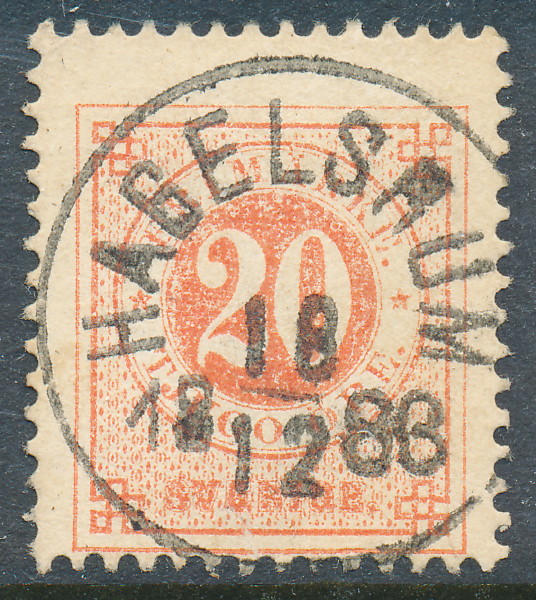
Pictured here is a copy of Sweden Facit nr. 33, 20 öre bright red Ringtyp perf 13, with an attractive "HAGELSRUM 18.12.1883" town cancel. It looks a bit like the cancel is from 1888, but the line at left is stray cancel ink-- when viewed from the back, you can clearly see the "3" of the date stamp. This is a nice example of the "normalcancellation 16," widely in use in Sweden during the latter part of the 1800s.
What is the value of this stamp? This is Facit 33e, the orange-red shade on "soft" paper, which has a catalogue value of 11:- Swedish Kr. The slightly yellowish shade of the stamp is normal on the soft paper printings-- the paper was typically slightly "cream" colored. The Hagelsrum cancel is a difficult one for cancel collectors to find, and this is a very nice example. Readable cancels from this postal place carry a premium value of 100:- Swedish Kr. and up. Given the quality of the cancel on a fault-free (although a bit off-center) stamp and the scarcity of the place, I'd estimate this stamp would sell for about 200:- to 250:- Swedish Kr. (US $31.50-39.50) at auction, perhaps higher if you were to buy it from a specialist dealer.
A bit about the place this stamp was postmarked: Hagelsrum is located just outside the small town of Målilla in Kalmar county in southeastern Sweden. Strictly speaking, it cannot even be characterized as a village; it is more like a "manor" with associated buildings, and a very small iron smeltery. However, it was-- in the 1800s-- significant enough to warrant its own postal collection point, most likely due to the commercial activity from the iron ore mill.
Local accounts suggest that the first settlements here were by Viking chieftains who'd "rest" in the area between long trips overseas. The first written accounts referring to the manor at Hagelsrum date to 1320, when the farming was most likely in care of a monastery based in the city of Vadstena. There were at the time three farms, a grain mill and an eel fishery in the vicinity.
Between 1447 and 1748, the property changed hands a number of times, was periodically claimed by the Swedish crown, and was burned down/ destroyed and rebuilt several times. There may have been a small castle built during one reconstruction, but this is uncertain as there are no remains found, today. For a while, the buildings were used for a munitions works; the iron smelter oven (basically a "blast furnace")-- which remains largely intact today-- was built from the ground up in 1853, and was in operation till 1877. The furnace is the only one of its kind in Kalmar county to remain well-preserved.
The postal station at Hagelsrum was active from December 1877 until January 1963. Today, mail from the area is processed at nearby Målilla. The current population of Hagelsrum is about 30 people.
What is the value of this stamp? This is Facit 33e, the orange-red shade on "soft" paper, which has a catalogue value of 11:- Swedish Kr. The slightly yellowish shade of the stamp is normal on the soft paper printings-- the paper was typically slightly "cream" colored. The Hagelsrum cancel is a difficult one for cancel collectors to find, and this is a very nice example. Readable cancels from this postal place carry a premium value of 100:- Swedish Kr. and up. Given the quality of the cancel on a fault-free (although a bit off-center) stamp and the scarcity of the place, I'd estimate this stamp would sell for about 200:- to 250:- Swedish Kr. (US $31.50-39.50) at auction, perhaps higher if you were to buy it from a specialist dealer.
A bit about the place this stamp was postmarked: Hagelsrum is located just outside the small town of Målilla in Kalmar county in southeastern Sweden. Strictly speaking, it cannot even be characterized as a village; it is more like a "manor" with associated buildings, and a very small iron smeltery. However, it was-- in the 1800s-- significant enough to warrant its own postal collection point, most likely due to the commercial activity from the iron ore mill.
![]() |
| The blast furnace at Hagelsrum |
Between 1447 and 1748, the property changed hands a number of times, was periodically claimed by the Swedish crown, and was burned down/ destroyed and rebuilt several times. There may have been a small castle built during one reconstruction, but this is uncertain as there are no remains found, today. For a while, the buildings were used for a munitions works; the iron smelter oven (basically a "blast furnace")-- which remains largely intact today-- was built from the ground up in 1853, and was in operation till 1877. The furnace is the only one of its kind in Kalmar county to remain well-preserved.
The postal station at Hagelsrum was active from December 1877 until January 1963. Today, mail from the area is processed at nearby Målilla. The current population of Hagelsrum is about 30 people.
Sunday, September 14, 2008
Fine and Rare, Number 4
The "Fine and Rare" pages of this blog is a space where I sometimes share some of the "gems" (in my opinion) and favorites from my personal collections. Some will be rare, some will just be of exceptional quality, some will merely be unusual-- a few will be "all of the above."
Sweden 1872: 20 öre red Ringtyp, perf 14, a very fine used example with full upright strike of extremely rare "FJÄRÅS KLOCKAREGÅRD 3.2.1877" town cancel. Facit number 22g. With certificate by Helena Obermüller-Wilén.
One of my primary specialized collections is of town cancels on classic Swedish stamps, namely the "Arms" and "Circle" types, issued between 1855 and about 1891. In Sweden, these stamp series are known as "Vapentyp" and "Ringtyp," respectively. I originally got interested in this area of collecting after purchasing an old accumulation from a dealer in Copenhagen, Denmark-- and noticing how attractive many early Swedish cancels were.
Cancel collecting is a "big deal" in Swedish philately. Collecting Ortstämplar (town/place cancels) is part of a popular trend known as "hembygdsfilateli" (literally "home municipality philately"), where collectors specialize in the postal history of a specific town, county or region of Sweden... typically the area where they grew up, or where their ancestors came from.
This stamp came to me some 15 years ago as part of a very disappointing mail auction lot, described as a "very fine specialized group of classic Sweden," which in fact was a group of primarily "awful spacefillers." This stamp was one of the better ones, VF and with just one nibbed perf-- still, no great rarity... until I looked up the postmark.
Fjärås Klockaregård was no more than a tiny "place," not far from the town of Kungsbacka in Halland, Sweden. Mail was only handled there from the beginning of 1874 till around March of 1877. As you can probably imagine, if you take a place with perhaps 100 people, in the 1870s, and a postal depot only open for a little over three years... you end up with very few surviving postmarks.
This became the first truly rare postmark in my Swedish cancel collection. I sent it off to Sweden for certification, and it came back with a clean "genuine" certificate.
The "base" value of Facit no. 22g is 70:- Swedish kr. (or about US$10.50). The cancel, however, carries a premium of 3500:- Swedish kr. (or about US$525.00) according to the Swedish Facit Postal catalogue. I have never seen another example of this rare cancel, either in auction catalogs, or in other collections.
Sweden 1872: 20 öre red Ringtyp, perf 14, a very fine used example with full upright strike of extremely rare "FJÄRÅS KLOCKAREGÅRD 3.2.1877" town cancel. Facit number 22g. With certificate by Helena Obermüller-Wilén.
One of my primary specialized collections is of town cancels on classic Swedish stamps, namely the "Arms" and "Circle" types, issued between 1855 and about 1891. In Sweden, these stamp series are known as "Vapentyp" and "Ringtyp," respectively. I originally got interested in this area of collecting after purchasing an old accumulation from a dealer in Copenhagen, Denmark-- and noticing how attractive many early Swedish cancels were.
Cancel collecting is a "big deal" in Swedish philately. Collecting Ortstämplar (town/place cancels) is part of a popular trend known as "hembygdsfilateli" (literally "home municipality philately"), where collectors specialize in the postal history of a specific town, county or region of Sweden... typically the area where they grew up, or where their ancestors came from.
This stamp came to me some 15 years ago as part of a very disappointing mail auction lot, described as a "very fine specialized group of classic Sweden," which in fact was a group of primarily "awful spacefillers." This stamp was one of the better ones, VF and with just one nibbed perf-- still, no great rarity... until I looked up the postmark.
Fjärås Klockaregård was no more than a tiny "place," not far from the town of Kungsbacka in Halland, Sweden. Mail was only handled there from the beginning of 1874 till around March of 1877. As you can probably imagine, if you take a place with perhaps 100 people, in the 1870s, and a postal depot only open for a little over three years... you end up with very few surviving postmarks.
This became the first truly rare postmark in my Swedish cancel collection. I sent it off to Sweden for certification, and it came back with a clean "genuine" certificate.
The "base" value of Facit no. 22g is 70:- Swedish kr. (or about US$10.50). The cancel, however, carries a premium of 3500:- Swedish kr. (or about US$525.00) according to the Swedish Facit Postal catalogue. I have never seen another example of this rare cancel, either in auction catalogs, or in other collections.
Thursday, April 03, 2008
Variety Focus: Sweden's 20/20 öre "Double Print" Stamp
A closer look at Sweden 1876: 20 öre red on 20 öre faint orange Ringtyp perf 14; Facit no. 23/Scott no. 23b
One of my specialized collections is of the Swedish "Ringtyp" (sometimes called "Circle Type") issues of 1872-99. Within these old sets of stamps, my favourite issue is the so-called 20 öre "Double Print" stamp, which is unique in the world of philately.
The first ringtyp stamps were issued on July 1, 1872, to replace the previous "Vapentyp" ("arms" type) stamps. Nine values between 3 öre and 1 riksdaler were issued, all perforated 14, all with the same basic design: a large central numeral of value inside a circle or "ring." One of the primary reasons for this stamp issue was that the numbers on the previous vapentyp stamps were small and sometimes difficult to read-- the ringtyp design featured a much more prominent numeral inside a circle in the center of the stamp.
The 20 öre value was printed in red. A number of printings between 1872 and 1877 produced an assortment of shades of red-- red was a difficult color to reproduce exactly. However, one of the printings of the 20 öre stamp was done in a colour of "dull orange" SO pale that the design could almost not be seen (Facit no. 22f). This printing was sent to post offices in 1875, but it quickly became a problem. Either the colour was too difficult to see, OR the stamp was confused with the yellow-orange 24 öre value.
As a result, the stamps were recalled by the Swedish Port Office (towards the later part of 1876), and it was decided that the stamps would be printed a SECOND time, this time in a brighter red colour-- rather than be destroyed.
Of course, with the fairly simple printing technology of the 1870s it was almost impossible for the printers to get perfect registration between the two colors, so most often the examples of the "double print" stamps we find have a faint "ghost image" of the paler colour-- on the stamp below, it can be seen in the right margin, and inside the large number 20. For a better look, click on the stamp and you'll get a much larger image to look at.
The listed catalogue value is relatively low, especially for a classic stamp of which only 180,000 were printed, and most were used and discarded on ordinary mail. I expect this is largely because only the Swedish Facit catalogue recognizes the stamp as a "main" number, while for all other catalogues the stamp is listed as a "variety." For Scott it is no. 23b, the other primary Scandinavian catalogue-- AFA-- lists it as no. 22x. As a result, most pre-printed album pages for Swedish stamps do not have a separate space for this stamp, even though it was an "official issue," and not an "error." If the album designers did include a space for the Double Print, the stamp would probably be worth 4-5 times more, because of the much higher demand to fill those empty spaces.
Another thing that makes this stamp interesting for collectors of Sweden is the "treasure hunt" factor. Although the variety is listed in most major catalogues, very few descriptions exist to tell people what to look for. Most copies I have found have come from duplicate stocks of the "normal" 20 öre stamp. Odds are good that next time you find yourself at a stamp show, you might just find one of these in a dealer's box, not marked as a vareity!
One of my specialized collections is of the Swedish "Ringtyp" (sometimes called "Circle Type") issues of 1872-99. Within these old sets of stamps, my favourite issue is the so-called 20 öre "Double Print" stamp, which is unique in the world of philately.
The first ringtyp stamps were issued on July 1, 1872, to replace the previous "Vapentyp" ("arms" type) stamps. Nine values between 3 öre and 1 riksdaler were issued, all perforated 14, all with the same basic design: a large central numeral of value inside a circle or "ring." One of the primary reasons for this stamp issue was that the numbers on the previous vapentyp stamps were small and sometimes difficult to read-- the ringtyp design featured a much more prominent numeral inside a circle in the center of the stamp.
![]() |
| Facit Nr. 22f, 20 öre printed in extremely pale orange |
As a result, the stamps were recalled by the Swedish Port Office (towards the later part of 1876), and it was decided that the stamps would be printed a SECOND time, this time in a brighter red colour-- rather than be destroyed.
Of course, with the fairly simple printing technology of the 1870s it was almost impossible for the printers to get perfect registration between the two colors, so most often the examples of the "double print" stamps we find have a faint "ghost image" of the paler colour-- on the stamp below, it can be seen in the right margin, and inside the large number 20. For a better look, click on the stamp and you'll get a much larger image to look at.
![]() |
| A genuine example of the "Double Print" stamp |
Another thing that makes this stamp interesting for collectors of Sweden is the "treasure hunt" factor. Although the variety is listed in most major catalogues, very few descriptions exist to tell people what to look for. Most copies I have found have come from duplicate stocks of the "normal" 20 öre stamp. Odds are good that next time you find yourself at a stamp show, you might just find one of these in a dealer's box, not marked as a vareity!
Subscribe to:
Posts (Atom)