Follow Scandinavian Stamps on Twitter!

Follow Scandinavian Stamps on Twitter!
Showing posts with label Future of stamp collecting. Show all posts

Friday, July 12, 2013

The Uneasy Relationship of Stamp Collecting and the Internet

Over the past few years, I have been writing quite a bit about stamp collecting and its future... outside the confines of this blog.

Whereas there is little doubt that the Internet has changed the nature of stamps collecting, I am increasingly coming to the conclusion that the online environment has helped save-- and continues to help save-- our hobby.

That said, I also see an interesting duality that has developed... a sort of rift between the "tech" and the "non-tech" stamp collectors of the world.

What do I mean by that?

Whereas there are many philatelists who have embraced the Internet as part of their collecting experience-- and actively use online stamp marketplaces and social media information to help build their collections-- there are also many who are still stuck in a "we don't NEED that" mindset.

Whereas I can appreciate we tend to adhere to the ways we are accustomed to, I can't help but think that stamp collectors who are not using (or "don't need") the Internet are going to end up going the way of typesetters and horse drawn carriages. Maybe that's just a "fact of life" but it makes me sad because these collectors have a wealth of knowledge to share with future generations of collectors.

The easy "argument" is that these collectors are primarily in their senior years, making them more resistant to embrace modern trends. In fact, I used to think that, myself... but on deeper examination, many of these folks who reject technology for stamp collecting are quite actively involved in online genealogy research and communities while using Flickr to share photos with their grandkids. So it's really not a "computer issue." Or an "age issue."

I have a twitter account... and a Facebook page... and a number of other online "presences." I belong to several online stamp collecting forums and communities. This morning, I was checking twitter and was once again just amazed by the low number of tweets relating to anything philatelic. The American Philatelic Society (APS) has 30,000+ members, but only 383 twitter followers. That's about one percent of the membership. What's silly about that is that I-- as an individual stamp collector-- have more twitter followers than the APS.

Maybe it's just "the nature of the beast." Stamp collectors tend to be solitary practitioners. They will often "join" things, but be non-participants. And maybe that is really the greatest challenge facing the stamp collecting hobby.

Saturday, October 15, 2011

Stamp Collecting and Building Community

I often talk about "community," on these pages.

One of the things the Internet has given us-- as stamp collectors, as hobbyists, as human beings-- is the opportunity to connect with others and develop more of a sense of community.

In days of old, "community" was pretty much a local phenomenon. You belonged to a local "interest" group-- be it a stamp club, or professional, or political organization-- in your village, your town, your city. That was your "community."
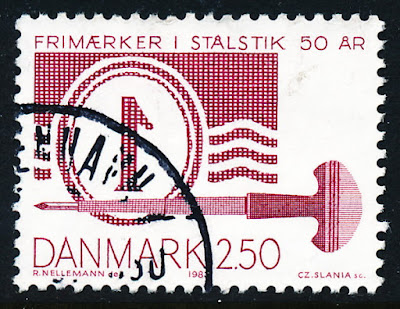
Denmark Scott 737/AFA 768, from 1983
In some interpretation of the world, stamp collectors-- and letter writers-- were among the first who reached out to the precursors of the "Internet," through the fairly common practice of "pen pals," during the Victorian age. "Penny Postage" allowed people in the UK-- and subsequently in other parts of the world-- to reach each other through "Pen Pal Clubs." In many ways, these were the pioneering days of becoming "friends" with someone you'd never actually met in person.

With the arrival of the Internet the idea of "communities formed around a common interest" has grown enormously. Suddenly, we were no longer "geographically dependent," which expanded our opportunities tremendously. Although many philatelists may pooh-pooh the idea of email and the www as a tool to save stamp collecting, fact remains that it's through the Internet we're now able to so easily connect with thousands of collectors around the world whom we'd never have had the opportunity to know, otherwise. Not only that, but we're able to find colleagues and friends, no matter how specialized our field of interest.

I am not unaware of the fact that stamp collecting historically has been a pretty "solitary" hobby... and I also recognize and honor that part of the appeal has been that stamp collecting was something you could "do alone." As such, I would expect a general "personality profile" of philatelists to include disproportionately many introverts and "loners," if compared to the general population... many of whom would simply not be interested in sitting alone in their study for hours, looking at little pieces of paper.

That said, we humans are ultimately "social" creatures... and no matter how introverted we may be, at least some measure of our collecting enjoyment comes from "swapping fish stories" with our peers; comparing and sharing what we have in our collections, and trading with others.

It's up to us, however, to reach out... rather than allow ourselves to grow isolated behind our computer screens. It's up to us to use these new types of media as tools to connect; rather than as an excuse to not have to leave the house, at all. It's up to us to re-create stamp collecting as a 21st century "community," as well as simply an interesting hobby we love.

As I have written before, stamp collecting will not survive-- and even thrive-- if our main effort goes towards trying to bring more "retirees" into the hobby, using the "old ways." It won't work-- especially not in the long run. The people we need to bring into stamp collecting are from "Generation Internet;" the first young people who grew up as "technology natives" with computers and social media.

"Occupy Wall Street" protest in Port Townsend, WA
Yesterday, I spent a couple of hours in the company of several hundred people staging a peaceful protest outside the local offices of a large national banking corporation, as part of the now globe-spanning "Occupy Wall Street" movement. One of the things I "took away" from this event is the notion that the old idea that "the youth of the world will change society" may be an increasingly outmoded concept.

Why?

Most members of "Generation Internet" are mired down in escalating student loans, the struggle to merely survive in a hostile and uncertain economy and a certain degree of hopelessness as greater and greater numbers resort to "moving back in with the parents." It is actually the 50-somethings and 60-somethings who have the experience, wisdom... and (usually) the time and financial resources to make a difference. Interestingly enough, the activist/protesters of the 1960s-- for a while "absent" to pursue the almightly dollar and material success-- now find themselves as the most qualified to be "world shapers and changers" in the 2010's. They are not merely (to use "Occupy Wall Street" terminology) "in the 99%," they are typically in the  80th to 99th percentile who have the most to lose.

The thing that saddens me a lot is that such large numbers of people who belong to this subgroup of "former activists" are deeply apathetic and indifferent-- complaining endlessly about the "decline" of the world, but then choosing to sit at home on the couch with excuses like "I can't make a difference, so why bother?" and "it's up to the YOUNG people, not up to ME."

Nonsense!

Getting back to stamp collecting, in order to appeal to "Generation Internet," we-- the "elders"-- must be willing to step outside our comfort zones to make room for them. That means not only being willing and open to using twitter, facebook, tumblr and online forums to talk about stamp collecting-- but embracing that "interesting stamps in 2011" may be what we (secretly, or not) would consider "useless wallpaper."

The future is now. Are we ready to embrace it and help create a new paradigm for stamp collecting? Or are going to passively stand by and allow our resistance to change to slowly kill the hobby love, and from which we've gained so much?

The next move is yours....

Friday, September 09, 2011

I Stopped Collecting Stamps in 1985...

Whoa.

Wait a minute.

This probably sounds a little strange for someone who's often going on and on about how we must try to bring new collectors into the hobby. Well, let me assure you that the title is not what it seems. So, let me explain what brought those words to mind.

I collect postally used stamps. My personal philosophy is that I like to have a collection of stamps that have "done" what stamps were designed to do: Carry the mail. For me, there is a certain charm and interest added by being able to look at a stamp and know that it carried some letter-- anything from a wedding invitation to a payment for a credit card bill-- from "Point A" to "Point B."

In fact, this part of philately/stamp collecting is so important to me that several of my collections are centered not just around the stamps, themselves, but around the postmarks on the stamps.

The collection I currently consider my "primary" is of town cancels on classic Sweden-- only on the issues of Scott/Facit nr. 1-51.

My broader Denmark specialized collection does consist of "one of each" but is also supplemented not merely with varieties and plate flaws, but also with what I think of as "luxury" cancels on all issues. In the US, collectors typically called them "Socked-on-the-nose" (S.O.N.).

So what's the issue?

As mail service-- and the way we communicate-- has entered the technological age, not only are we seeing fewer and fewer letters with stamps, but the way "snail" mail is being processed is increasingly automated.

From the perspective of my Denmark collection, hand cancels (like the one from Horsens, at right) pretty much became a thing of the past, during the mid- to late 1980's. But that's not all. Even nice machine cancels (like the one from the town of Års, upper right) started to fall by the wayside as more centralized mail processing became a fact of life.

What does that mean, in a practical sense? Well, local post offices stopped "handling" mail, and would simply bag incoming mail and send it-- by van or by train-- to central sorting facilities, where the postmarks would be applied. However, instead of 100's (or even 1000's) of different towns, Denmark ended up with just a handful of the postmarks of central sorting facilities.

The photo to the left shows a typical "modern" Danish cancel. It is certainly a "nice" one, and would fit my old qualifications for a "luxury" town cancel... except for the small detail that there is no longer a town involved. The cancel-- from 2010--reads (translated) "Central Sjælland's Postal Center." There is now just one standard postal marking for a region with 100's of towns and villages, and a population of some 300,000 people.

To me, that's just not very interesting. And that's why I realized that I "stopped collecting" around 1985, when town cancels started to go away.

Of course, I haven't actually stopped collecting. 1985 just became my "cutoff point," after which I no longer look for luxury cancels on newer issues.

Of course, this particular "issue" is not unique to Denmark. Other countries around the world are increasingly automating their mail delivery systems, and town cancels everywhere are becoming a thing of the past. In some places, cancels (as applied by a canceling device) have completely gone away, to be replaced by rather unattractive ink-jet "spray on" cancels.

Of course, many postal administrations still allow collectors to bring in their stamps to be hand cancelled by a postal worker at the post office. But whereas I can certainly appreciate the "extra effort" to keep stamp collectors happy, I must confess that I am a bit of a "purist:" Such cancellations-- while certainly "genuine" in all respects-- just do not fit my idea of "postally used."

Ultimately, I can't say that I blame the postal services of the world for "getting with the times." Everyone has to carefully watch where the money goes-- and in saving money, speed and technological advances often becomes a very important factor.

That said, it still makes me sad to realize that my stamp collections have become somewhat "finite;" that is, the possibility of ongoing expansion has gone away.