Follow Scandinavian Stamps on Twitter!

Follow Scandinavian Stamps on Twitter!
Showing posts with label stamp clubs. Show all posts

Saturday, February 04, 2012

The "Relative" Popularity of Stamp Collecting

I was born and raised in Denmark, and lived around Europe till I was 20 years old. Since I started collecting stamps when I was six years old, I can safely say that my original impressions of philately were shaped in Europe, and mainly in Denmark.

I have lived in the US since 1981 (I originally came here to go to University), and it has never taken a degree in rocket science for me to understand that stamp collecting in the US is just not as popular as it is in Northern Europe.

The American Philatelic Society (APS), of which I have been a member since 1984, has a group and discussion page on business networking site LinkedIn. Recently, there has been a fairly active discussion about stamps clubs and membership in stamp clubs.

Since we now have the Internet, access to "facts and figures" is much more convenient than in days of old, where writing letters and journeys to the library were required. So I decided to do a quick comparison study of the (apparent) popularity stamp of collecting in the US vs. stamp collecting in Denmark, just using "public" information.

Denmark is a small country, with a population of about 5,544,000 people. The primary organization for stamp collectors in Denmark is Dansk Filatelist Forbund, which currently has in excess of 6,000 members and 112 affiliated local and specialist stamp clubs.

The US is a large country, with a population of about 307,000,000 people. The primary organization for stamp collectors in the US is the American Philatelic Society (APS), which currently has right around 35,000 members, and somewhat in excess of 500 affiliated local and specialist stamp clubs.

If I "do the math" on this, the population of the US is 55.4 times greater than the population of Denmark. Applying that multiple to to the "known" stamp collector data from Denmark, we end up the "fact" that in order for philately's apparent popularity to be the same between the two countries, the APS would need to have 332,400 members and about 6200 local and specialist clubs.

Loosely speaking-- at least on paper-- stamp collecting appears to be ten times more popular in Denmark, than in the US.

But is this "The Truth?" What other factors could play into these numbers? Are Danish stamp collectors merely "more organized?" More likely to join clubs? Hard to say...

One possibility is that the US is-- geographically speaking-- a huge country. The population density of the US is about one-quarter that of Denmark. Access to, and distribution of, information, news and announcements-- regardless of the advent of the Internet-- tends to go down, as population density goes down. People who are widely scattered tend to communicate less-- regardless of what the topic might be. As a result, I believe there are far more "solo" (as in, non-club, non-society, collect in isolation) stamp collectors in the US, than in Denmark.

That's just a theory, though.

One of my great interests in life is "building communities," virtual, or real. The "fellowship of stamp collectors" is a community-- and I am very interested in what we (existing stamp collectors) might to do help our greater community of philatelists not only maintain in the 21st century, but even grow and thrive... in an era where "sending snail mail letters" is rapidly declining.

I look forward exploring the issue of how to help build the stamp collecting "community" in future articles on this blog. Stay tuned!

Thursday, January 12, 2012

Stamp Auctions, Nations, and "Image."

Today I'm going to pass up writing "about stamps" and instead embark on a little self-indulgent editorializing... although this definitely will relate to stamps and stamp collecting.

Yesterday I received a small printed "prospectus" in the mail from a large European stamp auction house. As a 40-some year collector, I've seen a few of these. I've also seen the way sellers of stamps present themselves... and what sort of "image" stamp collecting has, in different parts of the world.

As I read through this colorful brochure, I came to really have a moment of insight as to just how different things were-- and are-- for stamp collectors in parts of Europe, as compared to in the US. I don't know a lot about Asia and Australia, but I get the impression their stamp communities are doing fairly well.

I grew up in Europe; in Denmark, to be precise. Collecting stamps was pretty common. Nobody gave you a second glance if you told them you were a stamp collector. Odds were pretty good that when you talked to your neighbor, he or she probably was a stamp collector, too. Young people collected stamps, old people collected stamps, people somewhere-in-the-middle collected stamps. In the days before the Internet, you went to stamp stores... I had a list of about 20-25 of them around Copenhagen, that I'd go to. Some were good for supplies and stock books, some were good for kiloware, some were good for having "specials" on better stamps, now and then. Occasionally, I'd connect with my older cousin (also a stamp collector) and we'd go to a stamp show, or a stamp auction. I went to "stamp club" most weeks-- as I recall, Thursday afternoons were for "juniors." There was a stamp club in most suburbs.

I arrived in the US of A in 1981... to go to college at the University of Texas, in Austin. Naturally, I expected to find stamp collectors, stamp clubs and stamp stores, just like where I'd come from.

It was just part of the culture shock I experienced that there was no such thing. In a metro area of some 700,000, there was one small stamp club... which seemed to be (at least to my college eyes) made up of exclusively old men. It met once a month. My search for stamp dealers revealed just a couple... and one of them was "by appointment only."

So yesterday, I am looking at this brochure from the European auction house... it is now 30 years later. They do business from a large modern building. The "staff photo" reveals not a group of "old men," but a mostly middle-aged crew, about 60% men, 40% women. They certainly didn't appear "old and stuffy."

It made me realize how different the "image" of stamp collecting is, where I grew up vs. where I live now. I never got the impression people in Europe found it either "strange" or "uncool" to collect stamps... which was the subtle feedback I got when I arrived in Texas. It was as if "stamp collecting was for people to nerdy to have friends, and retired (usually military) people." More than once, I heard the words "Stamp collecting? Isn't that for OLD people?"

The negative connotations make me feel sad. I suppose what really makes me feel sad is that we seem to pay more attention to whether or not we are "doing something cool," than whether we're-- basically-- enjoying ourselves.

As I pondered this, I also realized that my collection has been built 95% by stamps purchased outside the US. Not because I have anything against purchasing from US dealers and auctions-- quite the contrary-- but I simply can't find what I am looking for, with any regularity, at all.

It does make me wonder, however, how the so-called "Hobby of Kings" has managed to get such a less than perfect "image," here in the US...

Saturday, October 15, 2011

Stamp Collecting and Building Community

I often talk about "community," on these pages.

One of the things the Internet has given us-- as stamp collectors, as hobbyists, as human beings-- is the opportunity to connect with others and develop more of a sense of community.

In days of old, "community" was pretty much a local phenomenon. You belonged to a local "interest" group-- be it a stamp club, or professional, or political organization-- in your village, your town, your city. That was your "community."
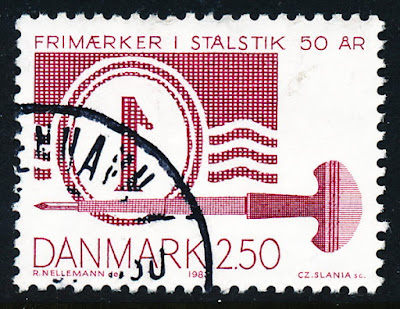
Denmark Scott 737/AFA 768, from 1983
In some interpretation of the world, stamp collectors-- and letter writers-- were among the first who reached out to the precursors of the "Internet," through the fairly common practice of "pen pals," during the Victorian age. "Penny Postage" allowed people in the UK-- and subsequently in other parts of the world-- to reach each other through "Pen Pal Clubs." In many ways, these were the pioneering days of becoming "friends" with someone you'd never actually met in person.

With the arrival of the Internet the idea of "communities formed around a common interest" has grown enormously. Suddenly, we were no longer "geographically dependent," which expanded our opportunities tremendously. Although many philatelists may pooh-pooh the idea of email and the www as a tool to save stamp collecting, fact remains that it's through the Internet we're now able to so easily connect with thousands of collectors around the world whom we'd never have had the opportunity to know, otherwise. Not only that, but we're able to find colleagues and friends, no matter how specialized our field of interest.

I am not unaware of the fact that stamp collecting historically has been a pretty "solitary" hobby... and I also recognize and honor that part of the appeal has been that stamp collecting was something you could "do alone." As such, I would expect a general "personality profile" of philatelists to include disproportionately many introverts and "loners," if compared to the general population... many of whom would simply not be interested in sitting alone in their study for hours, looking at little pieces of paper.

That said, we humans are ultimately "social" creatures... and no matter how introverted we may be, at least some measure of our collecting enjoyment comes from "swapping fish stories" with our peers; comparing and sharing what we have in our collections, and trading with others.

It's up to us, however, to reach out... rather than allow ourselves to grow isolated behind our computer screens. It's up to us to use these new types of media as tools to connect; rather than as an excuse to not have to leave the house, at all. It's up to us to re-create stamp collecting as a 21st century "community," as well as simply an interesting hobby we love.

As I have written before, stamp collecting will not survive-- and even thrive-- if our main effort goes towards trying to bring more "retirees" into the hobby, using the "old ways." It won't work-- especially not in the long run. The people we need to bring into stamp collecting are from "Generation Internet;" the first young people who grew up as "technology natives" with computers and social media.

"Occupy Wall Street" protest in Port Townsend, WA
Yesterday, I spent a couple of hours in the company of several hundred people staging a peaceful protest outside the local offices of a large national banking corporation, as part of the now globe-spanning "Occupy Wall Street" movement. One of the things I "took away" from this event is the notion that the old idea that "the youth of the world will change society" may be an increasingly outmoded concept.

Why?

Most members of "Generation Internet" are mired down in escalating student loans, the struggle to merely survive in a hostile and uncertain economy and a certain degree of hopelessness as greater and greater numbers resort to "moving back in with the parents." It is actually the 50-somethings and 60-somethings who have the experience, wisdom... and (usually) the time and financial resources to make a difference. Interestingly enough, the activist/protesters of the 1960s-- for a while "absent" to pursue the almightly dollar and material success-- now find themselves as the most qualified to be "world shapers and changers" in the 2010's. They are not merely (to use "Occupy Wall Street" terminology) "in the 99%," they are typically in the  80th to 99th percentile who have the most to lose.

The thing that saddens me a lot is that such large numbers of people who belong to this subgroup of "former activists" are deeply apathetic and indifferent-- complaining endlessly about the "decline" of the world, but then choosing to sit at home on the couch with excuses like "I can't make a difference, so why bother?" and "it's up to the YOUNG people, not up to ME."

Nonsense!

Getting back to stamp collecting, in order to appeal to "Generation Internet," we-- the "elders"-- must be willing to step outside our comfort zones to make room for them. That means not only being willing and open to using twitter, facebook, tumblr and online forums to talk about stamp collecting-- but embracing that "interesting stamps in 2011" may be what we (secretly, or not) would consider "useless wallpaper."

The future is now. Are we ready to embrace it and help create a new paradigm for stamp collecting? Or are going to passively stand by and allow our resistance to change to slowly kill the hobby love, and from which we've gained so much?

The next move is yours....

Tuesday, October 04, 2011

Stamporama

The Internet is a funny place.

I must also confess that I have a short little span of attention, and often get sidetracked by "shiny objects." In the case of the Internet, the shiny obejcts just happen to be web sites I end up at... as no particular part of what I was just doing, just a few minutes earlier.

A few days ago, I ended up on a web site called "Stamp-O-Rama."

Denmark Scott B5
Seemed like a very interesting site, and a bit of a departure from most stamp sites-- combining "forum," "stamp club" and "auction" features on one site. So I decided to apply for membership. The membership application process was also appealing, with the final notice that a "real live human" would review my application and approve my membership. Part of why that was appealing is that so many (stamp) sites are plagued by huge numbers of random spammers that ruin it for the legitimate collector and hobbyist. On an actual monitored site, I feel, there's a greater chance that only collectors will be present.

So, I sent off my application, and started checking my email box for my membership approval. The final web site note stated that "it could take several days," which seemed OK since the site is run by volunteers.

And so, the days passed. I patiently waited till October 2nd (12 days later), but did not heard anything back-- and I even checked my email spam filters, since unknown mail sometimes finds its way there. That made me a bit sad, so I'm wrote a note back to the email address on the initial "please wait for approval" letter to see if there was a problem-- and if anyone was still even there.

It's a sad truth of the Internet that many sites (of all kinds) are started with great enthusiasm, and then the founders of those sites lose interest when not as much activity as they expected happens on their sites. It's difficult and time consuming to run a web site-- still more difficult to get it to become a well trafficked "success" that many people use.

In this case, I was relieved that there was a fairly quick response. There had been some kind of mix-up, and I'd somehow been assigned the ID of a different member-- but the error was quickly taken care of. Since Stamporama is run by volunteers, it's understandable that sometimes things slide through the cracks-- I run enough web sites of my own to appreciate that. The Stamporama club/site secretary was very friendly and helpful.

Now I just look forward to exploring the site... and based ion what I've seen so far, I'd like to encourage others to do so, as well. Not only does this appear to be a friendly and fun community for stamp collectors, it also serves as part of the overall effort to help build stamp collecting communities online. Visit and join Stamporama today!


Thursday, March 24, 2011

Where Collectors Come From

I have long had an interest in "community building," as a central part of ensuring the continuance of the stamp collecting hobby. I strongly believe that if we make an effort to be more connected-- as collectors-- we present an image to potential newcomers as having something they'd "want to become part of."

If we portray an image of being "solitary and antisocial hermits in our dark studies," it will not serve us well, in this modern world where the Internet increasingly connects us all.

As "keeper" of this blog for some five years, I periodically sit down with the site's "visitor logs," which help give me a sense of "what's going on" and who's reading these pages.

Whereas Google (searches) has always been the primary referrer to this site, I noticed something interesting, the last time I looked at the site logs:

"Spanning the Globe"
"Google.com" (the "main," USA- and worldwide-based site) is not my top Google referrer. In fact, it's not even in the top three:

Google.co.uk (United Kingdom)
Google.ca (Canada)
Google.se (Sweden)
Google.co.in (India)
Google.com.au (Australia)
Google.com (US/World)

Of course, it's open to interpretation what this really means.

It could mean that stamp collecting is more "active" in top five countries listed, than in the US-- even though they all have much smaller populations.

It could mean that Scandinavia-- as a collecting area-- is more popular in the top five countries listed, than in the US.

It could mean that stamp collectors in the top five listed countries are more likely to use the Internet, than collectors in the US.

What it does tell me, however, is that we have the ability to connect globally, these days. There can still be "stamp clubs," even if they become increasingly online-based, and they may be stronger and more focused than ever.

It's all about connecting across common ground!